
This guide is part of our FOA Certification training.
Quick Answer
- FOA stands for the Fiber Optic Association, the international professional body for fiber optics. FOA certification is the credential it awards to technicians who train at an FOA-approved school and pass the exam.
- The ladder starts with CFOT (Certified Fiber Optic Technician), the entry level that needs no prior fiber experience. CPCT covers premises cabling, and the CFOS tracks cover specialist areas.
- IMT Computers is an FOA Accredited Training and Certification Centre and Corporate Member (#718) in Ikeja, Lagos, verifiable in the FOA's own school directory.
FOA stands for the Fiber Optic Association, the international professional body for fiber optics. "FOA certified" means a technician trained at an FOA-approved school and passed the association's exam, earning a credential such as CFOT (Certified Fiber Optic Technician), CPCT (Certified Premises Cabling Technician) or one of the CFOS specialist certifications. CFOT is the entry-level credential most fiber job postings ask for by name.
If you've searched for fiber optic training anywhere in Lagos, you've likely come across the term "FOA certified" or "FOA accredited" attached to some programs and not others. It's not just marketing language — FOA certification is a specific, internationally recognized credential system, and understanding what it actually means can save you from spending time and money on a certificate that employers won't recognize outside the classroom it was issued in.
What Is the Fiber Optic Association (FOA)?
The Fiber Optic Association is the international professional association of fiber optics, chartered specifically to promote professionalism in the field through education, certification, and standards development. It functions as an internationally recognized certifying body — not a single school or a national government agency — with an extensive network of approved training schools around the world, IMT Computers among them in Nigeria. Globally, the FOA has certified close to 100,000 fiber optic technicians, which is part of why an FOA credential is portable in a way that a locally-issued, unaccredited certificate simply isn't.
Why an Industry-Wide Certification Standard Exists at All
It helps to understand the problem FOA certification was built to solve. Before an independent, industry-wide standard existed, "fiber optics training" could mean almost anything — a rigorous, hands-on program at one provider, and little more than a slideshow at another, both handing out a document that said "certified" on it. Employers had no reliable way to compare technicians trained at different schools, and technicians had no way to prove their skills carried weight beyond the company or classroom where they trained. An independent certifying body solves this by setting one standard that every accredited school has to meet, so a CFOT credential means the same thing whether the technician trained in Lagos, Lagos state's neighbouring regions, or another country entirely.
Why FOA Certification Matters More Than a Generic Certificate
Plenty of training providers in Lagos advertise "fiber optics certification" without any external accreditation behind it — meaning the certificate only carries as much weight as the name of the school that issued it. FOA certification is different because it's independently defined and recognized: the curriculum, exam standards, and instructor qualifications are set by the association itself, not by any single training center. When a telecom employer sees CFOT or CFOS on a CV, they know exactly what skills that credential represents, regardless of which FOA-accredited school the technician trained at.
The Full FOA Certification Ladder
FOA certification isn't a single credential — it's a ladder, starting from a foundational entry point and branching into specialist tracks:
CFOT — Certified Fiber Optic Technician
The foundational, entry-level certification and the one most job postings ask for by name. It covers fiber theory, termination, splicing, and testing — everything a working technician needs to start.
CPCT — Certified Premises Cabling Technician
Focused on structured cabling — both copper and fiber — within buildings and premises, relevant for technicians working on internal network infrastructure rather than outside plant installations.
CFOS Specialist Tracks
Once CFOT-certified, technicians can specialize further through the CFOS (Certified Fiber Optic Specialist) tracks — including network design (CFOS/D), fiber-to-the-antenna work (CFOS/A), distributed antenna systems (CFOS/DAS), fiber characterization (CFOS/FC), FTTH (CFOS/H), outside plant (CFOS/O), and splicing (CFOS/S). Each track is aimed at technicians who want to build deep expertise in one specific area rather than remain generalists.
How FOA Certification Is Actually Earned
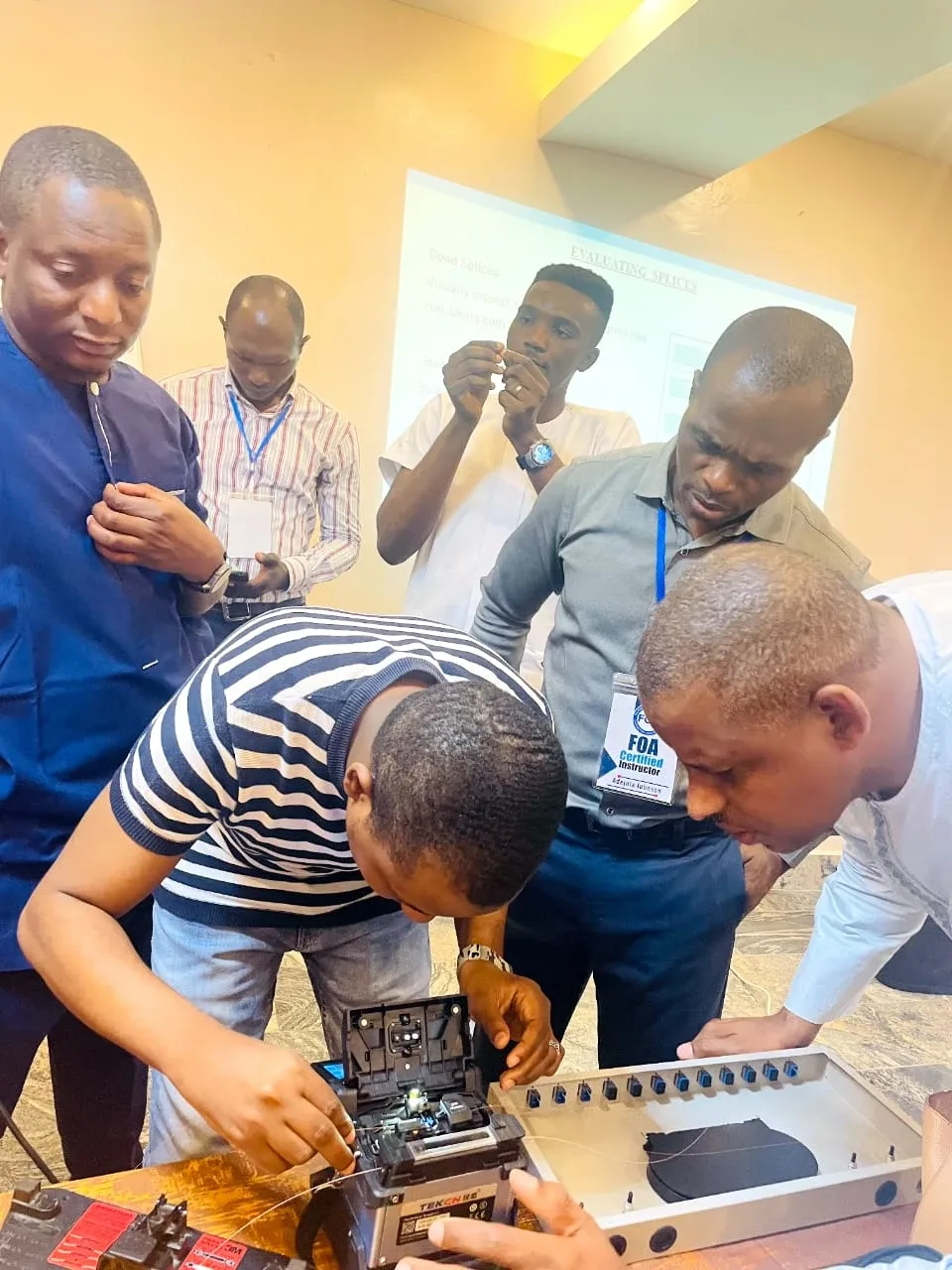
You don't earn FOA certification by watching videos or reading a manual alone. It requires training through an FOA-approved school — combining classroom instruction with hands-on practice on real equipment — followed by a certification exam. The hands-on component is non-negotiable in the FOA's model, which is precisely why the certification carries weight: it verifies you can actually perform the work, not just describe it.
A Practical Example: Comparing Two Job Candidates
Consider how this plays out in an actual hiring decision. A telecom company is evaluating two candidates for a fiber installation role. One holds a CFOT certification from an FOA-accredited school; the other completed a short, unaccredited "fiber optics" course at a local computer center. On paper, both list similar-sounding training. But the hiring manager can verify the first candidate's credential against an external, known standard — checking accreditation, understanding exactly what CFOT certification requires — while the second candidate's certificate offers no such reference point. In practice, this usually means the hiring manager either tests the second candidate's actual skills directly before trusting the certificate, or simply favors the verifiable credential outright. The accredited candidate isn't necessarily more skilled in reality, but they're able to prove it far more efficiently — which, in a hiring process, often matters just as much.
FOA Certification for Teams and Organizations
Individual technicians aren't the only ones who pursue FOA certification — telecom operators, ISPs, and installation contractors frequently certify entire teams at once, particularly when standardizing quality across a workforce or preparing to bid on projects that require certified staff as a contractual condition. Corporate or group training follows the same accreditation and exam standards as individual certification, just delivered at scale, and it's a common way organizations ensure every technician on a project meets the same verified baseline rather than relying on inconsistent informal experience across a team.
For organizations specifically, this also simplifies quality control on client-facing projects. When every technician on a job holds the same verified certification, a client or partner evaluating the contractor's capability has a single, consistent standard to check, rather than having to assess each individual technician's background separately. This is one of the quieter reasons FOA accreditation has become a common baseline requirement in contracts and tenders involving fiber infrastructure work — it shifts the verification burden from "trust our internal training" to "here's an externally recognized standard our whole team meets."
What Makes a Training Center "FOA Accredited"
An FOA Accredited Training Centre has had its curriculum, instructors, and equipment reviewed and approved directly by the Fiber Optic Association — it isn't a title a school can simply claim. IMT Computers is an official FOA Accredited Training Centre and Corporate Member, registered under member number 718, which means our CFOT, CPCT, and CFOS training programs follow the association's standards rather than an in-house curriculum built independently.
The Real Cost of Choosing an Unaccredited Alternative
It's worth being specific about what's actually at stake when someone chooses a cheaper, unaccredited "fiber optics" course over genuine FOA certification. The immediate saving is real — unaccredited programs are often priced lower precisely because they skip the accreditation, standardized curriculum, and exam infrastructure that comes with FOA training. But the deferred cost shows up later: a CV credential that a hiring manager can't independently verify, a skill set that may have gaps the student doesn't know about because there was no external exam to catch them, and, in some cases, having to retrain through an accredited provider anyway once it becomes clear the original certificate doesn't open the doors it was expected to. The upfront savings rarely offset the cost of effectively starting over.
FOA Certification and International Work Opportunities
Because the FOA operates an approved school network beyond Nigeria and certifies technicians across multiple countries, an FOA credential carries a portability that purely local certificates don't. This matters for technicians who might eventually consider contract work, relocation, or projects outside Nigeria — an internationally recognized credential removes one major point of friction that would otherwise require re-certifying from scratch in a new market. Even for technicians who never plan to work outside Nigeria, this portability reflects the underlying strength of the standard: it's built to be understood and trusted by employers who have never met the specific school where a technician trained.
FOA Certification vs. Non-Accredited "Fiber Optics" Certificates
The practical difference shows up the moment a technician applies for a job outside the city or company where they trained. An FOA certification is recognized by telecom employers across Nigeria and internationally, because the standard behind it is external and consistent. A certificate from an unaccredited local program may still reflect genuine skill, but the employer has no external standard to measure it against — which puts the burden of proof entirely on the technician during an interview or field test.
How FOA Certification Fits Alongside Other Qualifications
Many people pursuing FOA certification already have other qualifications — a university degree in an unrelated or loosely related field, a diploma, or prior work experience in a different industry entirely. It's worth being clear that FOA certification doesn't compete with or replace those qualifications; it adds a specific, verifiable technical credential on top of whatever background you already bring. An electrical engineering graduate who adds CFOT certification, for instance, combines formal theoretical training with a hands-on, internationally recognized practical credential — a combination that reads as more complete to an employer than either qualification alone. This is part of why FOA certification attracts such a broad range of people: it's additive to almost any existing background, not a replacement for one.
Who Should Pursue FOA Certification
FOA certification suits fiber optic technicians and installers, telecommunications and network engineers, ISP and telecom company staff being certified as a team, and Computer Science, Computer Engineering, or Electrical Engineering students looking to specialize in a hands-on technical field before or after graduation. No prior fiber optics experience is required to start at CFOT — it's built as the entry point, not a credential for people who already know the field.
If you're starting from zero and want a broader introduction before diving into certification specifics, our Fiber Optic Training in Lagos: Complete Beginner's Guide covers what training actually looks like day to day.
How FOA Certification Fits Into a Longer Career
It helps to think of FOA certification less as a single achievement and more as the start of an ongoing professional relationship with a recognized standard. Technicians typically begin with CFOT, build field experience, then layer specialist CFOS certifications on top as their career and interests develop — someone who starts out doing general installation work might, several years later, hold certifications in outside plant work and network design specifically because those are the areas they ended up specializing in on the job. The certification system is built to accommodate that kind of gradual, experience-driven specialization rather than forcing a single decision upfront about exactly what kind of fiber optics career you want.
How to Verify Someone's FOA Certification Is Genuine
This matters for two audiences: employers hiring technicians, and technicians who want to be able to prove their own credential holds up to scrutiny. Genuine FOA certifications are traceable — the certifying school and the technician's certification should be verifiable rather than taken purely on the word of a CV. If you're hiring, it's entirely reasonable to ask a candidate which FOA-accredited school they trained at and request to see the certificate directly, the same way you'd verify any other professional credential before relying on it for critical infrastructure work.
Certification Is a Foundation, Not the End of Learning
It's worth setting realistic expectations about what certification does and doesn't guarantee. Passing the CFOT exam confirms you've met a verified baseline of knowledge and hands-on ability — it doesn't mean every future job will be identical to what you practiced during training. Real fieldwork introduces variables a training lab can't fully replicate: unusual cable routing, older or damaged existing infrastructure, working conditions that aren't ideal. The certification gives you the foundation to reason through those situations correctly; it doesn't eliminate the learning curve that comes from real, varied field experience afterward. Technicians who treat certification as the finish line rather than the starting point tend to plateau faster than those who keep building judgment through every new job they take on.
This is also why the FOA structures its system as a ladder rather than a single credential — CFOT establishes the baseline, and the specialist CFOS tracks exist precisely because the association recognizes that real expertise in a specific area of fiber optics develops gradually, through a combination of continued training and accumulated field judgment, not from a single exam alone.
FOA Certification at IMT Computers
As an FOA Accredited Training Centre in Ikeja, Lagos, IMT Computers offers the full certification ladder — from CFOT through the CPCT and CFOS specialist tracks — taught by FOA-certified instructors in a hands-on training lab equipped with industry-standard fusion splicers, OTDRs, and testing equipment.
See the full range of certification tracks on our FOA Certification course category, or start with
CFOT (Certified Fiber Optic Technician), the foundational credential everyone begins with.
You can also verify FOA's certification standards directly on the Fiber Optic Association's official website.
Frequently Asked Questions
What does FOA stand for?
FOA stands for the Fiber Optic Association, the international professional association of fiber optics. It sets the training and exam standards behind credentials such as CFOT, CPCT and the CFOS specialist certifications, and approves the schools that teach them.
Is FOA certification recognized outside Nigeria?
Yes. The FOA is an internationally recognized certifying body with an approved school network operating in multiple countries, which is part of why employers treat FOA credentials as portable rather than locally-specific.
What's the difference between FOA certification and a regular fiber optics training certificate?
FOA certification follows a curriculum and exam standard set by the association itself, independent of any single school. A regular training certificate only reflects the standards of the specific school that issued it, with no external body verifying the skill level behind it.
Which FOA certification should I start with?
CFOT (Certified Fiber Optic Technician) is the foundational certification almost everyone starts with, regardless of which specialist area they eventually want to move into.
Do I need an engineering degree to pursue FOA certification?
No. CFOT, the entry-level FOA certification, is designed for beginners and does not require a prior engineering or technical degree.
How do I confirm a training center is actually FOA accredited?
You can ask the training center directly for their FOA membership or accreditation number, or check the Fiber Optic Association's official resources. IMT Computers, for reference, is FOA Accredited Training Centre and Corporate Member #718.
Can I pursue multiple CFOS specialist tracks after CFOT?
Yes. CFOT is the prerequisite foundation, after which technicians commonly pursue more than one CFOS specialist track over time, depending on which areas of fiber optics work they move into.
Does FOA certification expire, or is it valid for life?
Certification requirements and any renewal expectations are set by the FOA itself and can be confirmed directly through your accredited training center at the time of certification — it's worth asking this explicitly during your training rather than assuming.
Is FOA certification the same thing as a university engineering degree?
No — they're different types of credentials entirely. A degree reflects broad academic study, while FOA certification is a focused, hands-on professional credential specific to fiber optics work. Many certified technicians have no engineering degree at all, and some engineers pursue FOA certification specifically to add hands-on fiber optics skills to an existing academic background.
FOA certification exists specifically to solve a real problem in the fiber optics industry: making sure a credential means the same thing regardless of who issued it. If you're evaluating fiber optic training anywhere, checking for genuine FOA accreditation is the fastest way to know you're getting a certification employers will actually recognize, rather than discovering the gap only after you've already invested the time and money.
Learn more about IMT Computers' FOA-accredited programs on our About Us page, or
contact us directly with any questions about certification tracks — including which track fits your current experience level and career goals. If you already know you want to start with the foundational credential, see our related guide on
How to Become a Certified Fiber Optic Technician in Nigeria.
Related articles
- Inside Our Ikeja Training Lab: Fully Equipped for Practical FOA Training and Exams Company News · July 28, 2026
- IMT Computers Expands FOA Fiber Optics Training Programs Company News · October 10, 2025
- What It Takes to Become a Certified Fiber Optic Technician (CFOT) Industry Insights · January 8, 2026
- What Makes an FOA Accredited Center Stand Out Globally — And Where IMT Computers Fits In Company News · August 1, 2026